Vibratory Feeders,Automation Machines,Bowls,Feeders,Supply Hoppers

Supply Hoppers for Vibratory Bowl Feeders

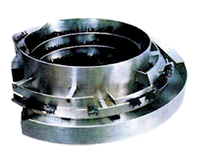
Most manufacturers that assemble products are familiar with vibratory bowl feeding systems. They generally consist of a bowl feeder, a linear power track (or gravity track) and a high limit switch in the track to turn off the bowl when the track becomes full. The feeder, track and switch are mounted on a steel plate or on a stand.

The size of the bowl feeder is determined by the size of the part being fed and the feed rate. Supply hoppers are used to increase the capacity of the bowl. Using one is usually more cost effective than making the bowl larger because a larger bowl is more expensive. A larger feeder also make more noise.

Another advantage of using a hopper is that the level of parts in the bowl is controlled. This allows the feeder to operate more efficiently and minimizes part recirculation.

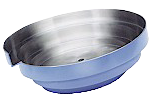
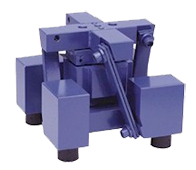
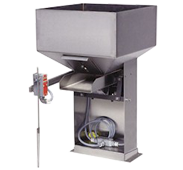
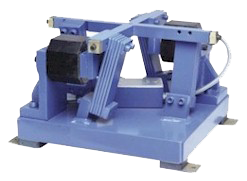
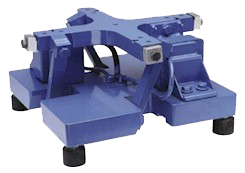
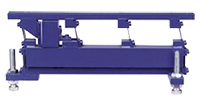
Most supply hoppers consist of a stationary bin supported over a vibrating tray. The tray moves the parts from the bin into the feeder bowl. The tray is turned on and off by a sensor in the feeder bowl. This sensor is most often a switch connected to a paddle that rises when parts are dumped into the bowl and falls as parts are fed out, or it could be a photo-optic or proximity sensing device. The feed rate is set by adjusting the door opening in the bin and by adjusting the amplitude of the vibrating tray.

When a supply hopper is used with a vibratory bowl feeding system, the controller that regulates the vibrating tray is interlocked with the feeder controller so that the hopper cannot go on unless the feeder is on. The supply hopper can be mounted on the same plate as the feeding system or on a separate height-adjustable floor pedestal.

Standard supply hoppers are used for parts that flow easily and are usually less than two inches long. The total weight of parts should not exceed 40 pounds.

Straight-front supply hoppers are similar to standard supply hoppers except for the straight-front, larger bin opening and wider tray. These modifications allow for the controlled feeding of parts that flow easily and are approximately three inches long. The total weight of parts being fed should not exceed 30 pounds.

Low-profile supply hoppers are the same as those above except their footprint is larger and their loading height is lower. These hoppers range in capacity from one half to six cu. ft. They are fabricated from 304 stainless steel or mild steel and are heli-arc welded. We recommend stainless steel hoppers.

Other sizes and types of supply hoppers are available for larger and heavier parts. For a low loading height, a hopper can be floor mounted and combined with a belt conveyor to lift parts into the feeder bowl.

Elevator hoppers that use the cleats of the belt conveyor to pull parts directly from the bin (no vibrating tray) are used for parts that tend to jam or bridge in a conventional hopper. This type of hopper is available in 5 to 20 cu. ft. capacities.