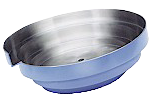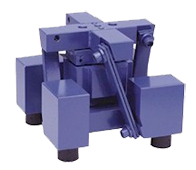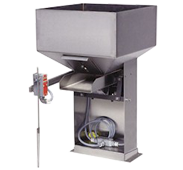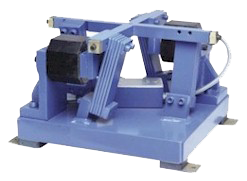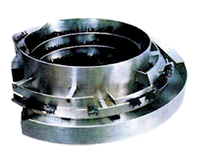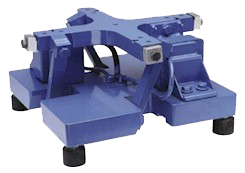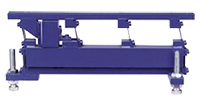
A vibratory feeder consists of a parts-orienting bowl
mounted on a vibrating drive unit with a variable-amplitude controller. The drive unit
vibrates the bowl causing parts in the bowl to move around a track that has been tooled to
sort and orient the parts in accordance with a customer's requirements.
Most feeder bowls are fabricated from #304 stainless steel. They are either outside-track or cascade types.
An outside-track bowl has inside tracks that are directly above
each other. Parts are then directed to the outside where there is a long distance for
tooling. This style of bowl is used when more intricate tooling is required for proper
part orientation, for higher feed rates, or for multiple lines of feed. The outside track
is usually pitched downward allowing parts to separate and be more easily oriented. By
tooling on the outside instead of on the inside, parts ten to buckle and fall into the
return pan instead of binding.
One of the considerations in determining the size of an outside-track
bowl is in the opening in the wall that allows parts that do not feed out of the bowl
to return to the inside. This style bowl is often coated with Surlyn to lower the noise
level and to reduce the amount of grinding and polishing necessary to meet FDA
requirements
A cascade bowl has outward spiraling tracks that are primarily
used for feeding easily oriented parts such as screws and dowels. They are often quieter
and less costly than outside-track designs. Since there are no"over and under"
tracks for parts to wedge between, improperly oriented parts are rejected back into the
bowl falling only to the lower track.
Cascade bowls can be coated with a variety of materials or
welded and polished to meed FDA requirements. They also lend themselves to lining with
sheet urethane for wear and noise abatement and with 3M Brushlon for feeding oily parts.
Good design for either style bowl includes holes and/or slots to remove dirt and foreign
matter.
Most parts fed in vibratory feeders are between 3/8 and 1 1/2 inches in their longest
dimension, with the practical limits being 1/8 to 8 inches. Feed rates are usually
determined by how much bounce a part can take with the feeder still controlling the part.
Linear feed rates of the bowl vary between 10 and 30 or more feet per minute. Parts that
are small, thin or difficult to orient will feed slower than larger or heavier parts. |