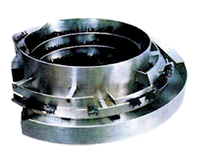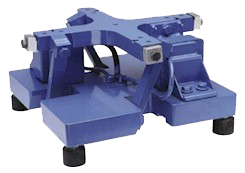
Vibratory Bowls - Bowl Feeders

Vibratory Bowl Feeders - After Installation

Since there are no moving parts in a feeder except the springs, what could happen to a feeder?

A problem could occur if the setup is incorrect. The feeder must be on a rigid support so that all the vibrations from the drive unit go to the bowl. A non-rigid support could create secondary vibrations that would affect the feeding. Once properly installed, most feeding systems will still be in running condition when the part that they have been feeding becomes obsolete.

Other problems that could occur that are easy to detect are a burned-out coil, a failed controller, or a broken spring. (A cracked spring is more difficult to detect.) Other faults that are not so obvious might require "re-tuning" the feeder.

What does "re-tuning" a feeder mean?

When a feeder is made it is "tuned" so that it's resonant frequency is close to the frequency of the input current. The moment of inertia of the bowl, the moment of inertia of the drive unit, and the stiffness of the springs determine the resonant frequency. Springs are added or removed to achieve the desired tuning. With 60-Hertz current, the electrons flow through the coils twice for every cycle, thus energizing the coils 120 times per second. (Larger feeders operating at 60 cycles per second use a rectifier to block the flow of electrons in one direction.) Tuning slightly under 120 cycles per second results in a smooth feed; tuning slightly over 120 cycles per second produces a feeder that is less subject to the weight of parts in the bowl.

Over a period of time, a feeder might become "out-of-tune"; that is, the resonant frequency could change. This usually results in a slower feed rate. This could be caused by springs becoming fatigued or becoming work-hardened, the screws holding the springs relaxing or working loose, or the spring clamps and spacers could have a build-up of particles or they could become permeated with oil. All of these effectively change the stiffness of the springs, and thus, the tuning.

Re-tuning a feeder consists mostly of adding and/or changing springs and screws. When this is done, it is important that the screws are TIGHT. It is also important that the coil gaps be reset properly to avoid damage or burnout of the coils. The gap between the coil and the armature should be even and as close as possible without striking.